As discussed in class, digital media tends to have both good and bad extremes when relating to diversity.
On one hand, digital media could allow people who haven't personally experienced diversity to see it on a wide scale in a whole new way. The Internet in general allows for instant access to any culture, although limited because you just have to sit at your computer. Its ease of access, for example, could lead a student to IU's GLBT Office when a student may never actually step into the office himself, which can embrace different cultures.
However, the argument exists that digital media just provides further exclusion for already marginalized groups.
To show both sides, the Media Diversity Institute recently put together a debate.
Ben Hammersley, editor of Wired magazine, says digital technology allows for valuable diversity of opinion.
Hammersley, along with other journalists and bloggers, all discuss if the Internet has just allowed for a community of like-minded individuals talking about only like-minded things here.
I do believe digital media is generally used to the well-being of most people and that most people benefit from having "the world at their fingertips." There are always those people who use things the wrong way or try to promote ideas against diversity, but it takes the consumer to be smart and moral to dig through what is right and wrong about digital media.
One potential issue I can see with digital media is its influence on children, who can be easily swayed in different opinions. If a child runs across a hate website like those we talked about in class, it could sway his opinion on diversity and possibly lead to issues. The Internet isn't always a good thing if left in the hands of those who want to cause trouble or who aren't fluent enough users to understand the differences in certain websites.
Thursday, November 4, 2010

Wednesday, October 27, 2010
Women of Color in the Media
I'm definitely one to believe there isn't a lot of diversity in media newsrooms. However, I do believe people of color, especially women of color, have made decent strides and will continue to do so.
For example, one of my most admired newswomen is Ann Curry. Until the discussion about women of color in media, though, I never thought about her being a woman of color. I only thought of her based on her journalism, which I believe people begin to miss when making the media a race issue.
The Washington Press Club Foundation put together an oral history project of women in journalism, which has firsthand accounts of women making it in the journalism business and the struggles and obstacles along the way. Although women themselves have had it a little difficult, women of color in journalism tend to have a double standard and have been left feeling like tokens or used for certain minority stories.
As our book states, white viewers tended to be more open to those newswomen who are of lighter skin minorities than darker. Coming from an all-white, small, country town, I have seen this firsthand and could be the reason why I don't see Ann Curry as non-white. Broadcast journalism is more superficial, so I don't think the issue of women of color in the media is considered really outside of broadcast. Back home, the anchors on most Cincinnati news stations are white, sometimes Asian or lighter-skinned women of color. From my experience, if women of color were apparent at all, they wouldn't be prime news anchors; they would usually be reporting on issues from the scene. Channel 12 News, for example, has very few people of color, but the anchors are usually always white.
However, I do believe the news usually doesn't make the culture, it mirrors it. I don't think seeing women of color in more media outlets is based on anything other than the culture in which we live. Until our culture changes its views, news will continue to stay the way it is.
For example, one of my most admired newswomen is Ann Curry. Until the discussion about women of color in media, though, I never thought about her being a woman of color. I only thought of her based on her journalism, which I believe people begin to miss when making the media a race issue.
The Washington Press Club Foundation put together an oral history project of women in journalism, which has firsthand accounts of women making it in the journalism business and the struggles and obstacles along the way. Although women themselves have had it a little difficult, women of color in journalism tend to have a double standard and have been left feeling like tokens or used for certain minority stories.
As our book states, white viewers tended to be more open to those newswomen who are of lighter skin minorities than darker. Coming from an all-white, small, country town, I have seen this firsthand and could be the reason why I don't see Ann Curry as non-white. Broadcast journalism is more superficial, so I don't think the issue of women of color in the media is considered really outside of broadcast. Back home, the anchors on most Cincinnati news stations are white, sometimes Asian or lighter-skinned women of color. From my experience, if women of color were apparent at all, they wouldn't be prime news anchors; they would usually be reporting on issues from the scene. Channel 12 News, for example, has very few people of color, but the anchors are usually always white.
However, I do believe the news usually doesn't make the culture, it mirrors it. I don't think seeing women of color in more media outlets is based on anything other than the culture in which we live. Until our culture changes its views, news will continue to stay the way it is.
Tuesday, October 12, 2010
Stereotypes and Scandals in Sports
Ask anyone about Michael Vick, and they could probably tell you about his dog fighting ring scandal before mentioning what team he now plays for in the NFL.
When you Google his name, articles still come up about the scandal, which happened years ago.
However, Google Brett Favre, and the first news articles that appear talk about the recent Monday Night Football game. That, or the ongoing discussion about whether playing this year was a good choice. You have to scroll down a ways before you come to what is the first big scandal against him: the cell phone seduction of Jets employees.
Why is this? People would probably definitely identify Favre as an NFL quarterback before citing the sex scandal. Is this an issue of race or subject? Is the subject of sex scandals just way too cliche from sports figures, or those in the spotlight in general, anymore?
Consider Favre's reputation thus far: Super Bowl-winning, Wrangler wearing family man who has made history in the NFL. He is currently the only NFL quarterback who is a grandfather. His career in the NFL is nearly unmatched by anyone else, and it's almost a joke these days talking about if he will retire or not.
How easy will it be for the media to tarnish Favre's image? I think pretty difficult. Deadspin.com, the site that broke the story of Favre by paying a certain amount of money to a third party, is relatively well-respected in the world of sports blogs, but I think ineffective of creating the hype necessary to bring Favre down. Some journalists have cited this discovery as a victory for media, but until anything is confirmed or not by Favre himself will be the only way I believe the controversy. What has journalism come to if unconfirmed stories run rampant?
Whether an issue of race or subject, it's still interesting to compare reputations of two very different NFL quarterbacks. That is, if people even consider Vick much of a respected quarterback anymore.
When you Google his name, articles still come up about the scandal, which happened years ago.
However, Google Brett Favre, and the first news articles that appear talk about the recent Monday Night Football game. That, or the ongoing discussion about whether playing this year was a good choice. You have to scroll down a ways before you come to what is the first big scandal against him: the cell phone seduction of Jets employees.
Why is this? People would probably definitely identify Favre as an NFL quarterback before citing the sex scandal. Is this an issue of race or subject? Is the subject of sex scandals just way too cliche from sports figures, or those in the spotlight in general, anymore?
Consider Favre's reputation thus far: Super Bowl-winning, Wrangler wearing family man who has made history in the NFL. He is currently the only NFL quarterback who is a grandfather. His career in the NFL is nearly unmatched by anyone else, and it's almost a joke these days talking about if he will retire or not.
How easy will it be for the media to tarnish Favre's image? I think pretty difficult. Deadspin.com, the site that broke the story of Favre by paying a certain amount of money to a third party, is relatively well-respected in the world of sports blogs, but I think ineffective of creating the hype necessary to bring Favre down. Some journalists have cited this discovery as a victory for media, but until anything is confirmed or not by Favre himself will be the only way I believe the controversy. What has journalism come to if unconfirmed stories run rampant?
Whether an issue of race or subject, it's still interesting to compare reputations of two very different NFL quarterbacks. That is, if people even consider Vick much of a respected quarterback anymore.
Tuesday, October 5, 2010
Discrimination by Sexual Orientation
Our recent discussion about the Rutgers University student who committed suicide after sexual relations with another man were broadcast online made me consider the GLBT community more locally.
A recent story found discrimination in an Indianapolis bakery after the owner cited moral objections to homosexuality as the reason he would not make rainbow-colored cookies for National Coming Out Day. Although this story is not nearly as serious as the student at Rutgers, this is a recent example of how our local community is not always accepting of different communities.
The incident at Rutgers raises many questions of the community's willingness to accept the GLBT population and the effectiveness of current policies in place. Any kind of discrimination should not be tolerated, and the school should have acted sooner on the first incident of its kind to handle the situation as quickly as possible. I think it's easy for most people to consider themselves not racist, but I believe one of the biggest prejudices people still have would be for the GLBT population.
I'm from a small country town in Indiana, and I know firsthand homosexual people are not very welcomed. Coming to IU, however, showed me the large support the community has. A recent opinion piece in the IDS discusses the role of the GLBT office here on campus. Although I am not part of the community myself, I do feel as if people are much more welcomed here. It's a topic from which many people try to stay away, but I believe it's the main prejudice of our century, and it's something that needs to be handled sensitively and correctly.
A recent story found discrimination in an Indianapolis bakery after the owner cited moral objections to homosexuality as the reason he would not make rainbow-colored cookies for National Coming Out Day. Although this story is not nearly as serious as the student at Rutgers, this is a recent example of how our local community is not always accepting of different communities.
The incident at Rutgers raises many questions of the community's willingness to accept the GLBT population and the effectiveness of current policies in place. Any kind of discrimination should not be tolerated, and the school should have acted sooner on the first incident of its kind to handle the situation as quickly as possible. I think it's easy for most people to consider themselves not racist, but I believe one of the biggest prejudices people still have would be for the GLBT population.
I'm from a small country town in Indiana, and I know firsthand homosexual people are not very welcomed. Coming to IU, however, showed me the large support the community has. A recent opinion piece in the IDS discusses the role of the GLBT office here on campus. Although I am not part of the community myself, I do feel as if people are much more welcomed here. It's a topic from which many people try to stay away, but I believe it's the main prejudice of our century, and it's something that needs to be handled sensitively and correctly.
Tuesday, September 28, 2010
Diversity in the Newsroom
The articles we discussed in class about the diversity in newsrooms really made me think about a couple of my past internships and their lack of diversity.
My first internship after my freshman year at IU was at a weekly paper in Oxford, Ohio. The staff consisted of only one reporter other than the editor -- both white men. The advertising department was run by a white woman, which offered a little bit of diversity in gender.
Until this class, I didn't exactly see how an all-male staff would influence news reporting. Then I began an internship in the marketing communications department at Miami University in Oxford, Ohio, where I now realize all the difference.
My direct supervisors in the publications department at Miami University were all women. Most of the management was, and I felt more at home. I feel as if we worked as more of a group (as we discussed in class) and allowed for more flexibility and creativity. My boss was more than understanding if something came up that changed the schedules for interviews or anything else I needed to do.
However, the one thing that has always seemed to lack is diversity in races. I've never, in all eight of my internships, worked for a direct supervisor who was not white. I remember my time at Miami as needing to be sure pictures published in student publication materials had students of different races and genders and how important it was to stress the campus as multicultural and diverse, even though most of the management was not.
As I look back, I used to wonder why management was so concerned about the issue of diversity in its creative materials, though I understand now both personally and how a business needs it.
This article we read in class really struck my interest. I've seen the push for more diverse newsrooms or work environments on a local level, but I think the Post pushes this limit. I didn't find this as much of a valid argument for hiring a more diverse newsroom. When it comes down to it, the media focuses on the "typical white male" kind of reader. And when you have older white males on the management staff, I think you can be sure news will stick that way.
Even with the lack of diversity I've seen in internships, I do believe the most diverse newsroom I've ever seen would be the Indiana Daily Student. As a reporter and editor there, I was able to interact with people of all races and genders, and I think anyone who has had experience there can consider themselves lucky -- even though they probably won't see this much out in the real world.
My first internship after my freshman year at IU was at a weekly paper in Oxford, Ohio. The staff consisted of only one reporter other than the editor -- both white men. The advertising department was run by a white woman, which offered a little bit of diversity in gender.
Until this class, I didn't exactly see how an all-male staff would influence news reporting. Then I began an internship in the marketing communications department at Miami University in Oxford, Ohio, where I now realize all the difference.
My direct supervisors in the publications department at Miami University were all women. Most of the management was, and I felt more at home. I feel as if we worked as more of a group (as we discussed in class) and allowed for more flexibility and creativity. My boss was more than understanding if something came up that changed the schedules for interviews or anything else I needed to do.
However, the one thing that has always seemed to lack is diversity in races. I've never, in all eight of my internships, worked for a direct supervisor who was not white. I remember my time at Miami as needing to be sure pictures published in student publication materials had students of different races and genders and how important it was to stress the campus as multicultural and diverse, even though most of the management was not.
As I look back, I used to wonder why management was so concerned about the issue of diversity in its creative materials, though I understand now both personally and how a business needs it.
This article we read in class really struck my interest. I've seen the push for more diverse newsrooms or work environments on a local level, but I think the Post pushes this limit. I didn't find this as much of a valid argument for hiring a more diverse newsroom. When it comes down to it, the media focuses on the "typical white male" kind of reader. And when you have older white males on the management staff, I think you can be sure news will stick that way.
Even with the lack of diversity I've seen in internships, I do believe the most diverse newsroom I've ever seen would be the Indiana Daily Student. As a reporter and editor there, I was able to interact with people of all races and genders, and I think anyone who has had experience there can consider themselves lucky -- even though they probably won't see this much out in the real world.
Tuesday, September 21, 2010
Advertising to Gay and Lesbian Audiences
While the Sender reading explained advertising through traditionally gay and lesbian media, another class of mine described the opposite: how traditionally straight publications market to the gay and lesbian market.
Though there are similarities, the differences are much more obvious.
We established in class that the gay and lesbian market is becoming more important for advertising because of the market's high status in culture. The market has a tendency to be more affluent, which makes it a prime target for advertisers.
The article we read in class spoke about the difference between marketing sexy and sleazy. However, in more mainstream media, advertisers try something a little less obvious, which is a strategy known as gay window advertising.
 One of the basic ideas of this strategy is marketing to the gay and lesbian community while remaining ambiguous to the majority population.
In the Calvin Klein ad above, the models are somewhat gender-ambiguous. It can be semi-difficult to tell the gender by first glance.
Another aspect could be the use of only male models or only female models, or the use of only one model, like this ad. With an ad of all female or all male models, it's undetermined that the advertiser is marketing toward any specific group. Also, with higher-end brands like Calvin Klein, the models are placed in such a way to promote sex without being sleazy, an important aspect for traditionally gay media.
It's important for advertisers in all media to start recognizing the gay and lesbian communities if they have not done so already. This audience is just as powerful as any other, and the products that market toward it will be successful.

Though there are similarities, the differences are much more obvious.
We established in class that the gay and lesbian market is becoming more important for advertising because of the market's high status in culture. The market has a tendency to be more affluent, which makes it a prime target for advertisers.
The article we read in class spoke about the difference between marketing sexy and sleazy. However, in more mainstream media, advertisers try something a little less obvious, which is a strategy known as gay window advertising.
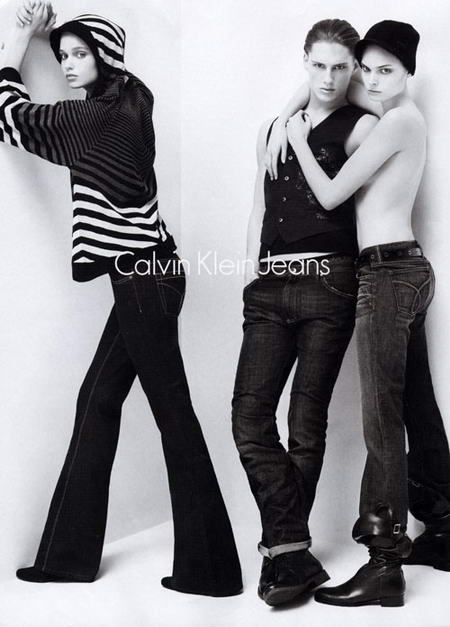 One of the basic ideas of this strategy is marketing to the gay and lesbian community while remaining ambiguous to the majority population.
In the Calvin Klein ad above, the models are somewhat gender-ambiguous. It can be semi-difficult to tell the gender by first glance.
Another aspect could be the use of only male models or only female models, or the use of only one model, like this ad. With an ad of all female or all male models, it's undetermined that the advertiser is marketing toward any specific group. Also, with higher-end brands like Calvin Klein, the models are placed in such a way to promote sex without being sleazy, an important aspect for traditionally gay media.

It's important for advertisers in all media to start recognizing the gay and lesbian communities if they have not done so already. This audience is just as powerful as any other, and the products that market toward it will be successful.
Tuesday, September 14, 2010
Native American Portrayal in Media
Native Americans are more than just feathers and loincloths.
As a person with Native American heritage, I am particularly interested in how the media has portrayed natives, especially in movies. Hollywood continues to shape the public's perception of Native Americans, but not always in favorable ways.
For example, Pocahontas depicts natives as the Indian princess, and most Westerns typically have Native Americans in a violent, savage role.
And who can forget the classic Cowboy/Indians game? Cowboys, of course, were the good guys, while Indians were the bad guys. Young boys idolize cowboys, and this influence of Native Americans is stereotypical.
Even in some movies and films about Native Americans, the native roles themselves were played by white or other foreign actors. This puts the idea of a Native American culture as a spectacle. Natives were given a few different roles: the Indian princess, the warrior and the noble savage, just to name a few. Though filmmakers did begin to feel somewhat guilty about the Native American situation, I feel that natives still have to fight against stereotypes such as the alcoholic or trusty sidekick.
In contemporary times, the biggest way I feel that Native Americans continue to be stereotyped is through sports mascots.


To me, I think the use of Indian mascots is demeaning. I don't think a lot of people see it this way, though, because non-Native American people usually see it as an honor. But would we ever use a Black or Hispanic person as a mascot? I think not.
Our discussion about minorities in films and movies has caused me to take a deeper look into the movies I have always enjoyed to see what kind of minority stereotypes I've been missing. I've always felt strongly about Native American portrayals, but our discussion makes me think to look a little deeper.
As a person with Native American heritage, I am particularly interested in how the media has portrayed natives, especially in movies. Hollywood continues to shape the public's perception of Native Americans, but not always in favorable ways.
For example, Pocahontas depicts natives as the Indian princess, and most Westerns typically have Native Americans in a violent, savage role.
And who can forget the classic Cowboy/Indians game? Cowboys, of course, were the good guys, while Indians were the bad guys. Young boys idolize cowboys, and this influence of Native Americans is stereotypical.
Even in some movies and films about Native Americans, the native roles themselves were played by white or other foreign actors. This puts the idea of a Native American culture as a spectacle. Natives were given a few different roles: the Indian princess, the warrior and the noble savage, just to name a few. Though filmmakers did begin to feel somewhat guilty about the Native American situation, I feel that natives still have to fight against stereotypes such as the alcoholic or trusty sidekick.
In contemporary times, the biggest way I feel that Native Americans continue to be stereotyped is through sports mascots.

To me, I think the use of Indian mascots is demeaning. I don't think a lot of people see it this way, though, because non-Native American people usually see it as an honor. But would we ever use a Black or Hispanic person as a mascot? I think not.
Our discussion about minorities in films and movies has caused me to take a deeper look into the movies I have always enjoyed to see what kind of minority stereotypes I've been missing. I've always felt strongly about Native American portrayals, but our discussion makes me think to look a little deeper.
Wednesday, September 8, 2010
A Deeper Look into White Privilege
One issue during class really struck my interest - white privilege and how it presents itself in media.
White privilege, as we discussed in class, is a relatively contemporary issue. However, I find it a semi-confusing one, as the very definition of white privilege varies depending on where I'm searching. Though it's not difficult to find information on the issue, it's just difficult to sort through it.
It seems to me the issue of white privilege has a community of its own. But from what I can tell, the idea of white privilege points back to one thing: a sense of power.
This ABC news special from 1989 explains the issue of white privilege by studying children's thoughts.
Many movies still demonstrate white privilege by continuing to have white males playing the most powerful, heroic roles. Though this isn't always the case, such as Crash (1994), shows white privilege in more subtle ways. This clip contains a scene where white privilege is discussed.
White privilege is not something I usually consider (probably because I am white), but it's rather easy to detect when I really started looking. The media is full of examples, and I'm sure the issue will continue to change the way I consume it on a regular basis.
But here's a little food for thought - there's an interesting clip on the irony of white privilege from a popular speaker, Tim Wise. He uses more contemporary examples, such as Hurricane Katrina, to describe how white privilege has, in some ways, worked against whites and the idea of power.
White privilege, as we discussed in class, is a relatively contemporary issue. However, I find it a semi-confusing one, as the very definition of white privilege varies depending on where I'm searching. Though it's not difficult to find information on the issue, it's just difficult to sort through it.
It seems to me the issue of white privilege has a community of its own. But from what I can tell, the idea of white privilege points back to one thing: a sense of power.
This ABC news special from 1989 explains the issue of white privilege by studying children's thoughts.
Many movies still demonstrate white privilege by continuing to have white males playing the most powerful, heroic roles. Though this isn't always the case, such as Crash (1994), shows white privilege in more subtle ways. This clip contains a scene where white privilege is discussed.
White privilege is not something I usually consider (probably because I am white), but it's rather easy to detect when I really started looking. The media is full of examples, and I'm sure the issue will continue to change the way I consume it on a regular basis.
But here's a little food for thought - there's an interesting clip on the irony of white privilege from a popular speaker, Tim Wise. He uses more contemporary examples, such as Hurricane Katrina, to describe how white privilege has, in some ways, worked against whites and the idea of power.
Subscribe to:
Comments (Atom)